
Abe Setzcen
An analysis of a key technique

Introduction
What is absetzen?
The usual interpretation of this Liechtenauer technique is based on the Ringeck, Danzig, Lew (RDL) texts. It typically goes something like this:
Pseudo Danzig:1
Here note that this is the text and the gloss of how one shall displace thrust and cut
Learn to displace
Skillfully disrupt cuts and thrusts
Whoever thrusts at you
Your point hits and theirs breaks
From both sides
You will hit every time, if you step.Gloss. Note the displacing. Conduct it like this: When you come to the opponent with the initiation of fencing, if they then set themselves against you as if they will thrust, then advance your left foot and setup against them in the guard of plow from your right side and offer yourself open on your left side. Then, if they thrust into that opening, wind to your left side, your short edge against their sword engaging their thrust and displace it with that and step in with your right foot with that and stab them Indes in their face or in their breast.
Paraphrased: Your opponent threatens a thrust (i.e. point is on line), you adopt a point on line guard of your own and offer an opening. When they take the offer you parry with a wind and riposte with a thrust of your own.
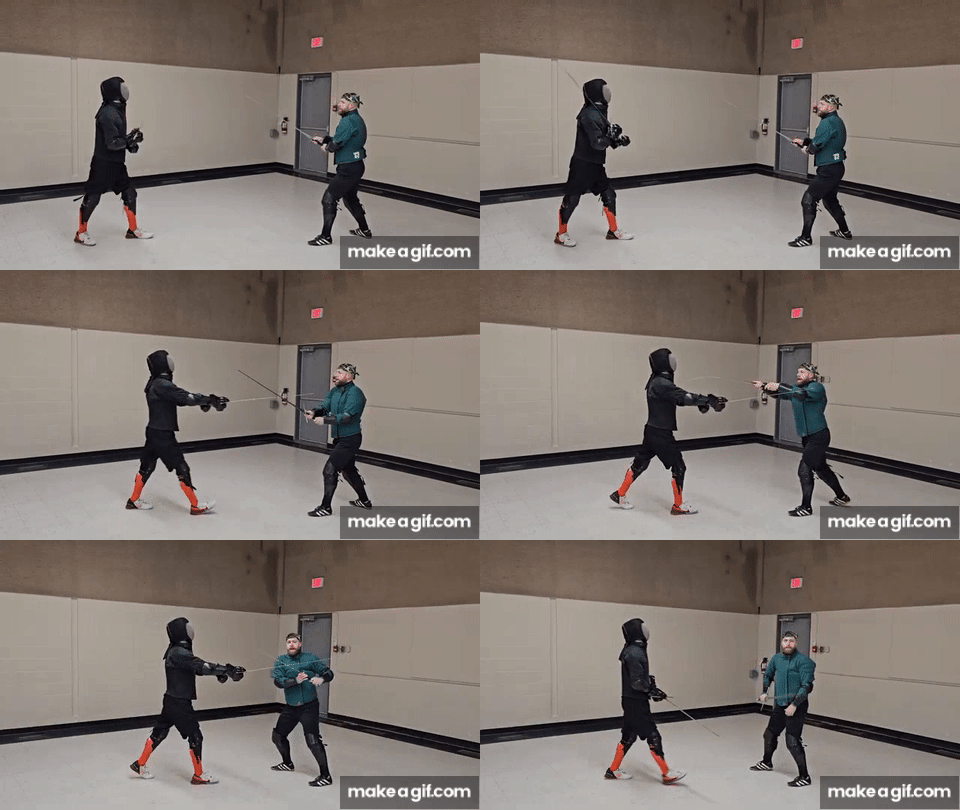
This is a very good, practical, useful technique. It makes for solid defence and often achieves a clean riposte. It’s also always a crowd-pleaser when you execute it in competition, and let us admit that we fencers like to show off when we can.
But as a student of Ms3227a, this technique is not directly described within the Codex.
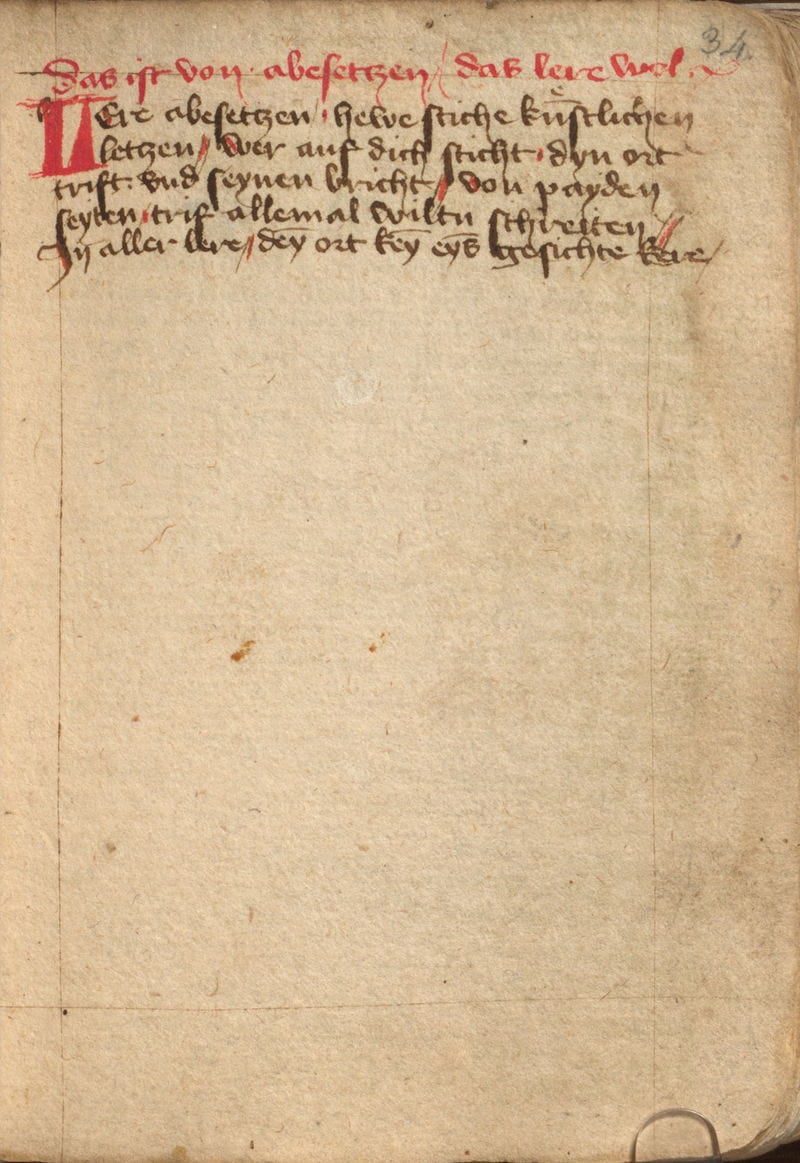
The absetzen lines within the Zettel are provided. Unfortunately, the author did not provide a gloss explanation. The page, Fol 34r, has a blank space. Perhaps the scribe intended to fill it in later, but it was never completed.
When reading the gloss recently, I noticed something interesting in the text around the four guards.
Trosclair translation:
The first guard, Plow, is this. When you lay the point forward, upon the earth. Or to the side after [abesetzen], this is also called the barrier-guard or the gate.
One of the many differences between 3227a and other Liechtenauer texts is that it refers to its point low position as Plow, Pflug, where others refer to this as Alber, the Fool.
Let’s set aside the debate about whether or not this is correct for the moment. Here we have the 3227a Author connecting the technique of Absetzen with point low positions. This passage is discussing a point low position, and also says that a point low position is where we end after Absetzen.
This intrigued me. The RDL variant on Absetzen is essentially a point on line technique. It relies on a retracted but point on line starting position (the RDL Pflug), and it hits with the point. Here, 3227a has connected Absetzen with a position where the point is down and to the side.
Thinking that this is a worthy issue for exploration, I decided to embark on a textual analysis of how “absetzen” is used in 3227a. I wanted to determine whether 3227a’s use of this term is the same as the RDL technique, or if there was some difference here that might be worth noting or learning from.
I have also recently become quite focused on what I call the defensive system within Liechtenauer fencing2. This is those aspects of the fencing approach whose function is primarily defensive, which prevent the opponent from landing hits. Absetzen appears to be such a technique, and so it is worth discussing and understanding alongside other defensive tools like Hengen, Abwenden, and Vorsetzcen.
Linguistics
Bear in mind, my knowledge of medieval German is developing as I study the Codex but it remains very much rudimentary. Take anything I say about linguistics with a grain of salt.
Absetzen, or in the older German of the codex, “Abesetzen”. Sometimes it is also spelled “Abe Setzcen” or “Abesetzcen”.
This word is a German verb, composed of “ab-”, a prefix meaning “off, aside, or away” and “setzen”, meaning “set or place”. 3
“Absetzen” then can be translated with terms like “To set off”, “to place away”, or “to place aside”.
Grimm’s German Dictionary provides some more details on the usage of this verb. Absetzen has a wide range of uses, such as: Setting an item down from the hand; Dismissing an official or a politician from their position; Deposing a monarch or ruler; Refuting an accusation or setting aside evidence in court; Separating verses in a poem; And, even to describe a surgeon amputating a limb4.
The general impression is that this verb is about getting rid of something, and often by physically relocating it. The uses around dismissing or deposing officials are, according to the Grimms, a stronger term and based around getting rid of someone due to an offence rather than a more routine resignation or replacement.
Absetzen in the Pseudo-Dobringer Text
As noted before, the Absetzen verse in the Zettel is unfortunately not glossed by the 3227a Author. This leaves us groping in the dark as we attempt to grapple with this technique. Even so, we do have 3227a’s Zettel verse5 to work with.
This is about setting off, learn this well:
The setting off, learn to do,
That cuts and thrusts be ruined before you.
Whoever makes a thrust at you,
Your point meets theirs and breaks on through.
From the right and from the left,
Always meet them if you'll step.
In every lesson that you learn,
Your point toward the other's face will turn
Chidester has here used a modified version of the rhyming Zettel created by Harrison Ridgeway. A plainer version is also given by Christian Trosclair’s translation:
This is about displacing. Learn this well.
Learn to displace
Skillfully disrupt cuts and thrusts
Whoever thrusts at you
Your point hits and theirs breaks
From both sides
You will hit every time, if you step.
In every lesson,
Turn the point against one's face.
What do we observe in this verse?
The first thing that catches my attention is actually in the header line. “Learn this well” stands out to me, das lere wol in the German.
Perhaps this is just an unimportant bit of text. However, it is unusual to have this little bit of extra instruction in the header. Most of the section headers only say something like Das ist von deme Twerehawe etc, “This is of the Crossing Cut, et cetera”. Occasionally these headers also say something like “mark this” or “look closely”.
The only other time a header tells us to do something wol (Well or completely) is at the start of the general preface. Das ist eyne gemeyne vorrede / des blozfechtens czu fuße / Das merke wol. “This is the general preface of the unarmoured fencing on foot. Mark this well”.
“Wol” is worth noting. As Maciej Talaga explains: “the adjective wol [is] used throughout the text to denote things done in a complete, sure, and reliable way (e.g. wol weren ader abeleiten, fol. 19v)”6
So the header here is telling us first of all we have to learn the Absetzen, but also that we need to learn the Absetzen well, which seems to suggest learning it completely. Perhaps this means it is particularly important to completely understand and be able to execute this reliably?
Now let’s move on to the verse itself.
“The setting off, learn to do,” / Lere abesetczen
Absetzen is an action that has to be learned.
Other specific things the Codex tells us to “lere” include fuhlen and indes, winden, hengen, durchwechsel, and abwenden. I have a suspicion that “lere” suggests aspects of fencing which are a bit higher in complexity and rely more on technical skill.
“That cuts and thrusts be ruined before you.” / hewe stiche künstlichen letczen
Trosclair gives this line as “Skilfully disrupt cuts and thrusts”, which is closer to a strict translation of the German phrase. “Kunstlichen letczen” could also be rendered as “Skilfully ruin” or “Artfully punish”.
Absetzen is a technique which counters or ruins cuts and thrusts.
Whoever makes a thrust at you / Wer auf dich sticht
Your point meets theirs and breaks on through. / dyn ort trift vnd seynen bricht
If the Opponent makes a thrust at you, Absetzen allows you to thrust them in return. Trosclair’s translation is also a bit clearer on this, stating “Whoever thrusts at you / Your point hits and theirs breaks”. They will fail to hit, and you will succeed.
This line also tells us one way Absetzen can strike the opponent: With the point of your sword.
3227a is very point-emphasizing as longsword sources go, stating in its general preface that “the point of the sword is the center, the middle, and the core, which all fencing proceeds from and returns to”. So it makes sense to me that Absetzen would enable a thrust.
From the right and from the left, / Von payden seyten
Always meet them if you'll step. / trif allemal wiltu schreiten
The Ridgeway Zettel says “from the right and from the left” for the sake of metre, but the German here is closer to Trosclair’s “from both sides”. The meaning is the same in either case. The Absetzen can be done to either side.
The second line is given as “always meet them” by Ridgeway, and as “you will hit every time” by Trosclair. Does this mean always meeting their blade or always hitting their body? “Trif”, or “treffen” throughout the rest of the Codex is usually used to refer to striking the opponent, so most probably it means you can always land your strike to either side with this action.
We also get a bit of footwork here. “Schreiten” in 3227a’s footwork seems to mean using a passing or walking step7. This footwork is connected to the idea of hitting with the Absetzen. Perhaps this means the actual strike of Absetzen is delivered with accompanying footwork?
In every lesson that you learn, / In aller lere
Your point toward the other's face will turn / deyn ort keyn eyns gesichte kere
These lines are an addition to this section in 3227a and don’t occur here in the RDL texts8. This couplet is repeated several times through the Codex (fols 23r, 33r, 65r, etc).
In the context of Absetzen, the idea seems to be that our point has perhaps traveled away from a threatening position as part of the action of the “setz ab”. This requires that we bring it back into threatening our opponent’s deep targets, with some kind of a turning movement.
Let’s consider this idea of turning the point towards the face in the context of the earlier mentioned passage about the position of Plow.
The first guard, Plow, is this. When you lay the point forward, upon the earth. Or to the side after [abesetzen], this is also called the barrier-guard or the gate.
According to this, after we conduct Absetzen (‘noch dem abesetzen’) our point is expected to be aimed downwards (Upon the earth) and to the side. If we want to follow that with a strike with the point at the opponent’s face (or chest as 3227a often states to strike to the head or body) then we must angle the point back from that position towards the opponent’s targets.
To summarize:
Absetzen is a technique or action to be “learned well” or “learned completely'“. It may be comparable to other skill-oriented things we are directed to learn, like fuhlen and indes.
Absetzen fulfils a defensive function, countering an opponent’s cuts or thrusts.
Absetzen can strike with the point of the sword. The striking component seems to be combined with the footwork, a passing step.
Absetzen can be performed to either side.
It is connected to positions with the point low and to the side.
Due to this, it requires a turning motion to bring the point back into threat.
This tells us a lot of goal oriented details. We have a fairly good idea here of what our Absetzen should achieve. The overall impression I get from these lines is that it is a parry-riposte of some sort, striking with the thrust.
Unfortunately, there isn’t much further detail provided in the Pseudo-Dobringer gloss, which hampers trying to create a more detailed reconstruction of this technique within 3227a. We are not told where to begin the action, what to do with our blade, which edge to use, or any of the other details which the RDL texts provide.
Must we use the RDL frog DNA to fill in this gap? That’s not such a bad thing, it’s a perfectly sound technique.
But, I want to go a little further and a little deeper into 3227a though and see what else we can find in this specific text.
Absetzen in the Other Masters Text
Ms3227a has a ‘chapter’ which addresses the fencing of the “other masters”: Andres Juden, Jobs von der Nissen, Nicklass Preußen, and the priest Hans Döbringer9. Before we go into discussing how Absetzen appears in this chapter, it is worth discussing the context of this material.
Now assessing the connection of this material to the Liechtenauer fencing found elsewhere in the text is fraught. The Codex Author clearly prefers the Liechtenauer approach, as he says in his preface:
“This is what Master Liechtenauer had acquired and formulated quite completely and correctly.
Not that he identified and worked it out himself, as was written before, rather he had traveled through many lands and through that sought out the legitimate and truthful art for the sake that he would truly experience and learn it.
And this art is earnest, complete and legitimate”
(Trosclair translation)
But the author also notes: “there is but one art of the sword and it was identified and worked out for possibly many hundred years. And this is the foundation and core of all of the arts of fencing.”. The text does not claim that Liechtenauer created the art of fencing, but that in the author’s view Liechtenauer had the best and most correct understanding of fencing.
At the same time, the “other masters” are listed as masters. They are implicitly acknowledged as being skilful enough to be worth discussing, even if the author thinks Liechtenauer was better.
The author also says:
I will not mention many of these master fencing techniques because you can find them before and completely in Liechtenauer's art and fencing, according to real art. However for the sake of practice and school fencing I will briefly and simply describe some techniques and methods of their fencing.
So the author thinks there is a considerable overlap between Liechtenauer fencing and the fencing of these other masters. As he regards it, Liechtenauer better describes fencing. However, he also thinks some of these techniques are worthwhile for training or for recreational fencing.
So in discussing Absetzen in the Other Masters text, it is worth keeping this context in mind: The Codex author thinks that there is just one art of the sword, and that Liechtenauer had the best understanding of it. So in exploring a term like “Absetzen”, we should prioritize the evidence in the Liechtenauer gloss but the Other Masters text may have relevant points as well.
In the case of Absetzen, it’s something the Liechtenauer gloss mentions but does not explain, so we are using the Other Masters text for additional information.
With that context, let’s look at how Absetzen is used in these passages. We’ll start with the verses on the Iron Gate guard:
Whatever they strike or thrust / was sy of dich hawe vnd stechen
against you, weak them with absetzten / das saltu mit abesetze~ swechen
Strongly upwards from the ground / stark of von der erden
so you will put them to shame / zo magstu sie wol beschemen
Like the earlier Zettel verse, these lines refer to the Absetzen countering cuts and thrusts from the opponent.
What is interesting here is that we get some implied directionality about the movement. This Absetzen is “strong from the earth”, stark of von der erden. This suggests an upward trajectory of this technique.
The Master Builder
One technique is called the Werkemeister (master builder) and comes from the low hanging from the left side, and it is the threatening with the point after the Absetzen. It may be well done from the gate, if the point turns against the adversary.
There is an old argument about how 3227a identifies the guards of Plow (Pflug) and Fool (Alber) and how it is different from how the RDL sources do. As seen above, the position with the point on the ground in front or beside the fencer is called Plow in the Codex. The Fool is associated with the lower hengen: “The third guard, the Fool, is the low hanging, with it one breaks all cuts and thrusts whosoever commands it correctly”.
The low hengen therefore cannot be a point on ground position, because that is called Pflug, Shrankhut, and Pforte in this text. The upper hengen from the shoulder is associated with the guard of Ochs, and with the technique of Twerhaw. The usual interpretation is that 3227a’s lower hengen is a position with the point and blade forward and the hilt below the shoulder, more or less what other sources call Pflug.
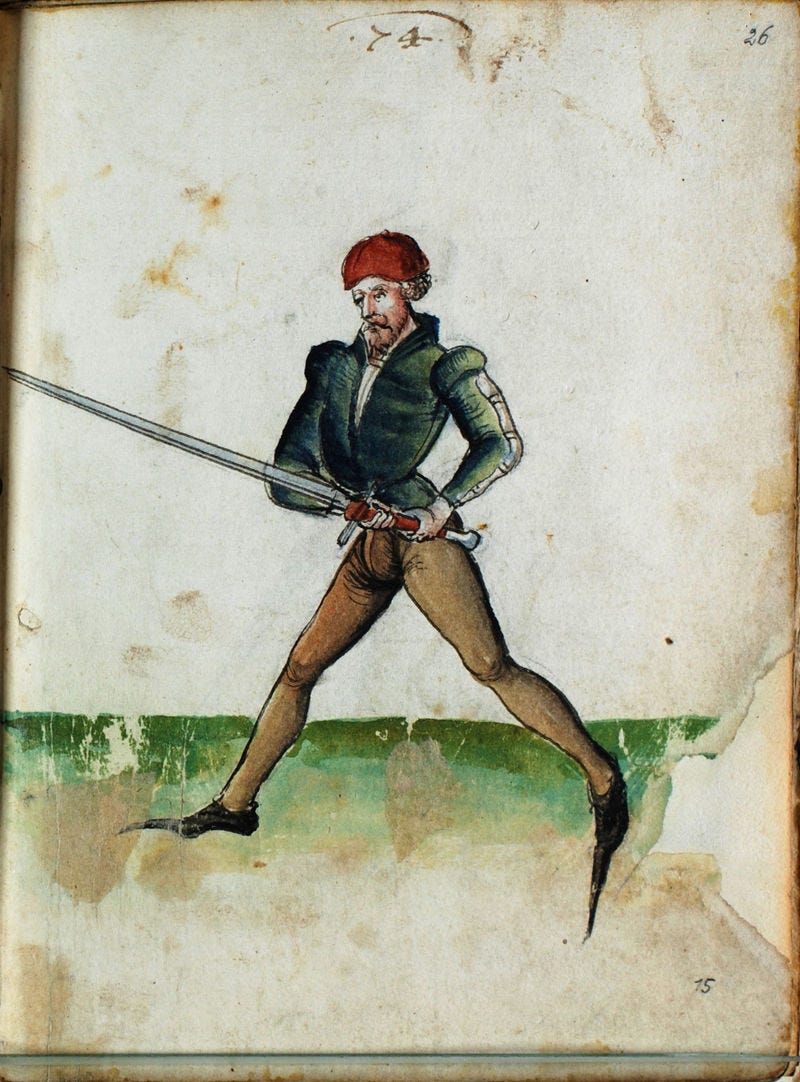
So here in the Weckemeister technique, we have a mention of a technique from a low hengen on the left. The technique also involves performing an absetzen before you threaten, “noch dem abesetzcen”.
I initially thought that this technique referred to raising into the low hengen after having performed an absetzen from a low guard, in order to threaten the thrust. But after conversing with Maciej Talaga on the matter, he pointed out to me that a more probable interpretation is that the technique starts at the low hengen, then performs the absetzen (i.e: Lower the point to shrankhut and absetz from there).
Mutatis mutandis, this does seem to better resemble how RDL uses Absetzen, which is interesting.
The Three Strikes
One technique is called the three strikes and it is an Underhau from the right and then an Underhau from the left strongly against his sword with the Absetzen and the third strike directly to his vertex and this one will hit.
Once again the Absetzen is connected to an upward motion from a low position, in this case an Unterhaw from the left.
Here we also see it specified that the Absetzen is directed against the opponent’s sword and in a preparatory role. The fencer in this technique does not strike with the Absetzen with the point as implied in other areas of the text, but uses the Absetzen to set themselves up for a strike at the opponent’s head.
As I interpret this technique, the Absetzen from the left moves the opponent’s sword aside to the right and thus opens up the opponent for the strike at the head.

An alternative interpretation here is that this use of absetzen, “mit abesetze” in the German, may be a “generic absetzen”. That is, perhaps this use is not referring to a specific technique but to using an unterhaw which moves the opponent’s sword aside. “Ab setz” rather than “The Absetzen”. If this is the case, then this passage could be misleading as to the actual specific technique which we are concerned with.
The Barrier Guard
One technique is called the Schrankhut (barrier guard) and comes from the point so that you put the point down to the ground to whichever side you want and thus you place yourself to the Absetzen. It may also be done from the gate when someone puts the point down to the ground in front of himself. And now if someone strikes or thrusts you so grab the point of the opponents sword while moving upwards with the Absetzen and strike him low to his feet or above or wherever he may hit him best.
Shrankhut also appears in the main Liechtenauer gloss of 3227a, in the earlier quoted passage about the Plow10. This position may be one of those elements which overlaps between Liechtenauer and the other masters.
This passage is particularly key because it gives us the most technical detail on how Absetzen is performed from Shrankhut.
Does “placing yourself to the Absetzen” mean “adopt the position from which you can launch the Absetzen” OR “adopt the position that an Absetzen would end in”? The Plow passage would support the end position thesis, as it states Shrankhut occurs noch dem abesetzen, after the set-aside. However in this technique, Absetzen is launched from Shrankhut as well. It appears that Absetzen is something we can do that takes us into this position, and is something which can also be launched out of this position.
Again the trajectory of the Absetzen is given as upwards. In this case we are also given a specific target on the opposing sword. The Absetzen targets the point, the weak of the opponent’s sword.
The follow up strikes here go to “wherever he may hit him best”, but it is very notable that the specific example given is a strike low to the feet or legs of the opponent11. Perhaps the standard follow up to Absetzen was expected to be a cut or thrust at the upper targets, and so a strike to the legs could have an element of surprise.
This passage also concludes with an odd line saying that this technique is similar to Pfobenzagel, the Peacock’s Tail, another of the Other Masters techniques. Thomas Stoeppler believes this was a mistake and ‘corrected’ the line in his translation to say it is more similar to Krauthacke, an up and down striking technique. I do not know which the scribe meant to write in, but I do think there are practical and plausible interpretations of Absetzen which can resmble the circling movement of Pfobenzagel.
Describing Absetzen
Out of all of that, can we come up with a set of distinct and identifiable facts and qualities which Absetzen in 3227a should have? Let’s try.
Absetzen:
-Defensive or preparatory action.
-Moves against the opponent’s sword, aimed at the weak.
-Moves the opponent’s blade aside
-Defeats cuts and thrusts.
-Can be used to set up strikes high (head) or low (feet), or thrusts.
-Striking requires a step
-Moves upwards from the low positions.
-Can be done to either side.
-Can be launched from low positions like Shrankhut or from the lower hengen
-Ends in low positions of Shrankhut and Pforte.
-Ends with the point somewhat to the side, necessitating a turn to threaten.
There is a certain amount of distance implied here as well by the fact that the strike is delivered with a step and that the thrust is provided as the riposte. I would say the Absetzen as described in 3227a is a parry-riposte at a medium to long distance, in which the point can be brought into play in between the fencers and the strike finished with a pass.
It is not described within the texts, but I think a preparatory retreat may be useful footworks here for maintaining that distance situation for succeeding at Absetzen. You also may want to end with weight on the front foot, so that the back foot can be used to pass with the strike.
Shrankhut and Pforte
As we have seen, Absetzen in both the Liechtenauer and Other Masters sections of Ms3227a is often connected with low positions, specifically these things called Shrankhut or Pforte. The technique seems to be launched from that position, as well as able to end in it. Unfortunately, the details on these positions are very sparse.
In order to interpret the actions, we do need some notion of what these positions are.
The only real details we get from Ms3227a itself is that Shrankhut/Pforte involves aiming the point “upon the ground” and to the side. There’s a vast array of possibilities this could encompass, so I had to turn to non-3227a sources to try to narrow things down.
In the circa 1530-1540 Goliath fechtbuch (MS Germ.Quart.2020), Shrankhut is portrayed as such:
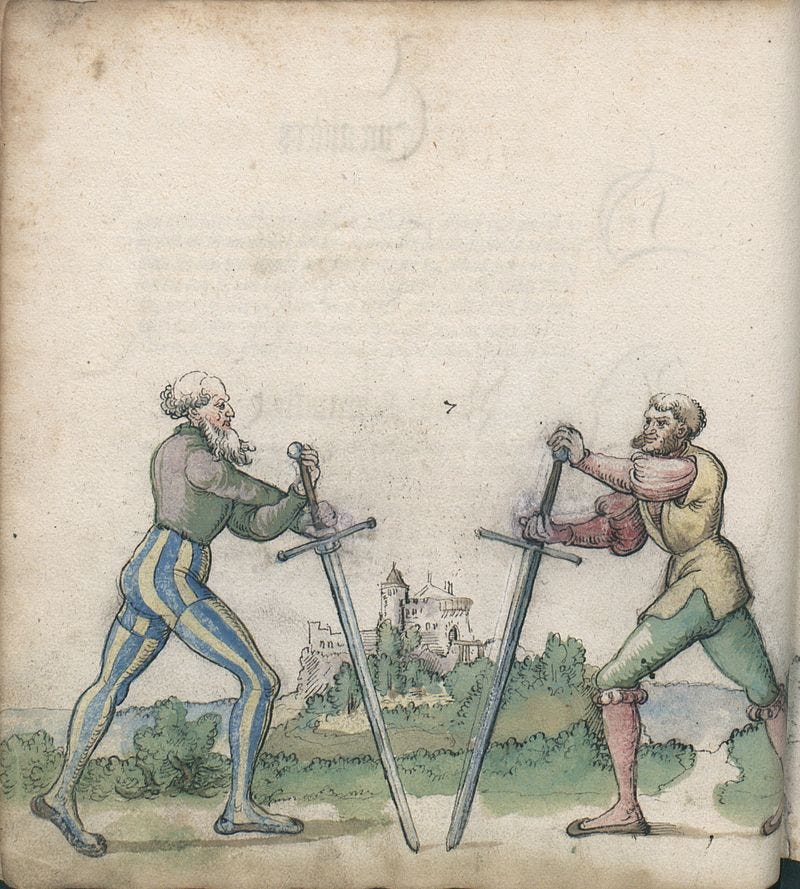
There are similar positions found in other sources, such as the treatise of Andre Paurenfeydnt:
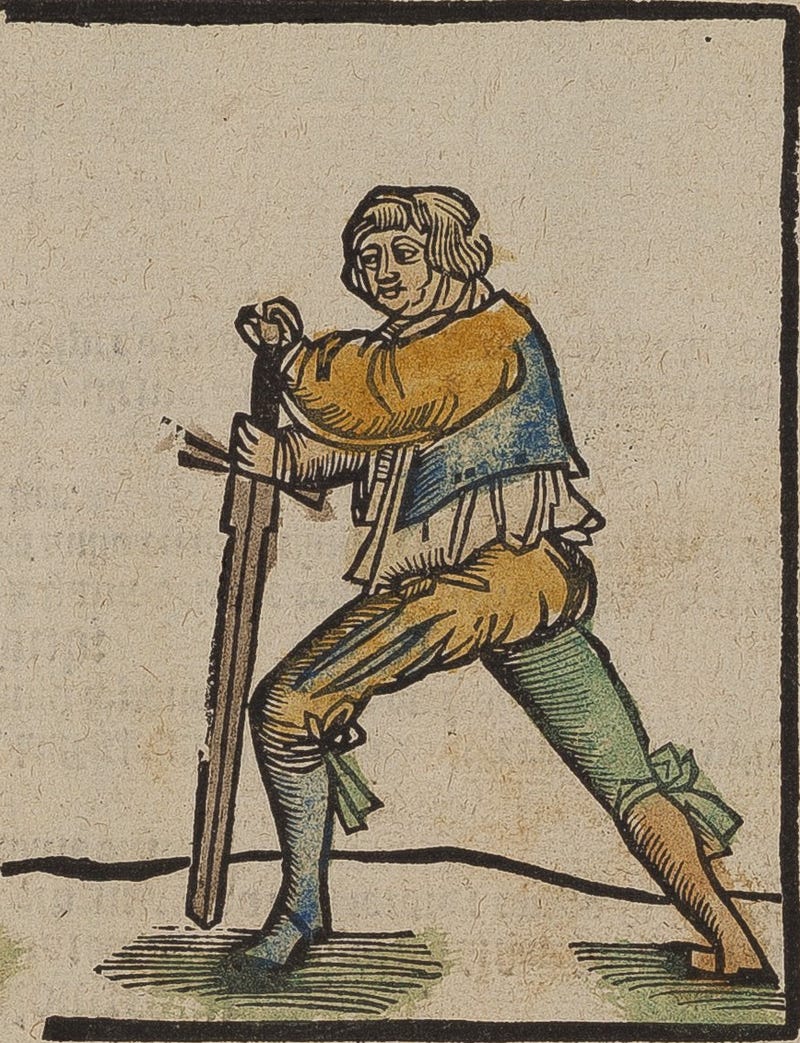
This position does indeed lay the point upon the ground and to the side of the fencer. However, I find it too extremely exaggerated for 3227a’s purposes. I have an upcoming article about how guards and positions are used in 3227a, so I won’t get into depth at this time, but I think this position is too fixated on defence only and a good 3227a guard should enable defence or offence equally.
The works of Hans Talhoffer is where I found a Pforte I much prefer:
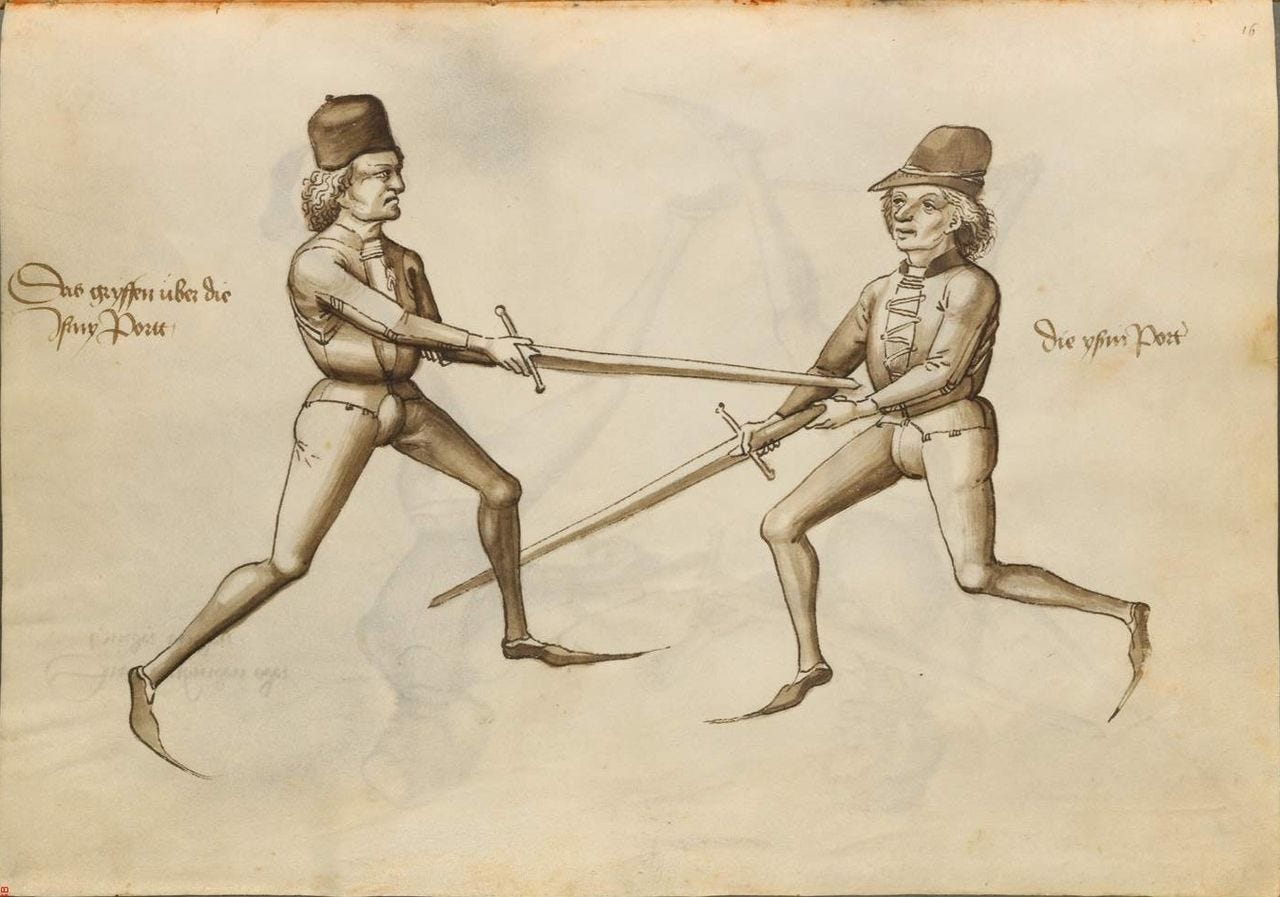
Or, in my modern interpretation of this position:

The point is still aimed at the ground and directed somewhat to the side. However, I am less to the side than some other variants on the position. The arms are also less extreme in their position, they are relaxed and ready for extension. What is important to me here is that this position both be capable of launching attacks and making defences.
Proposed Interpretations
As the Codex says: “You can't speak or write about fencing and explain it as simply and clearly as it can be shown and taught by hand.”
For this reason, I made a video show some proposals for how this technique may work.
These are, simply, proposals. I have not yet refined these to the point of reliable application in my free fencing. These are by no means the final word, merely my thinking of the moment. Also do note that these are demonstrations, and not live use in sparring, and so are of less value than live examples.
The three methods I demonstrate here are a rising Absetzen with the back edge, rising with the front edge, and a circle parry version.

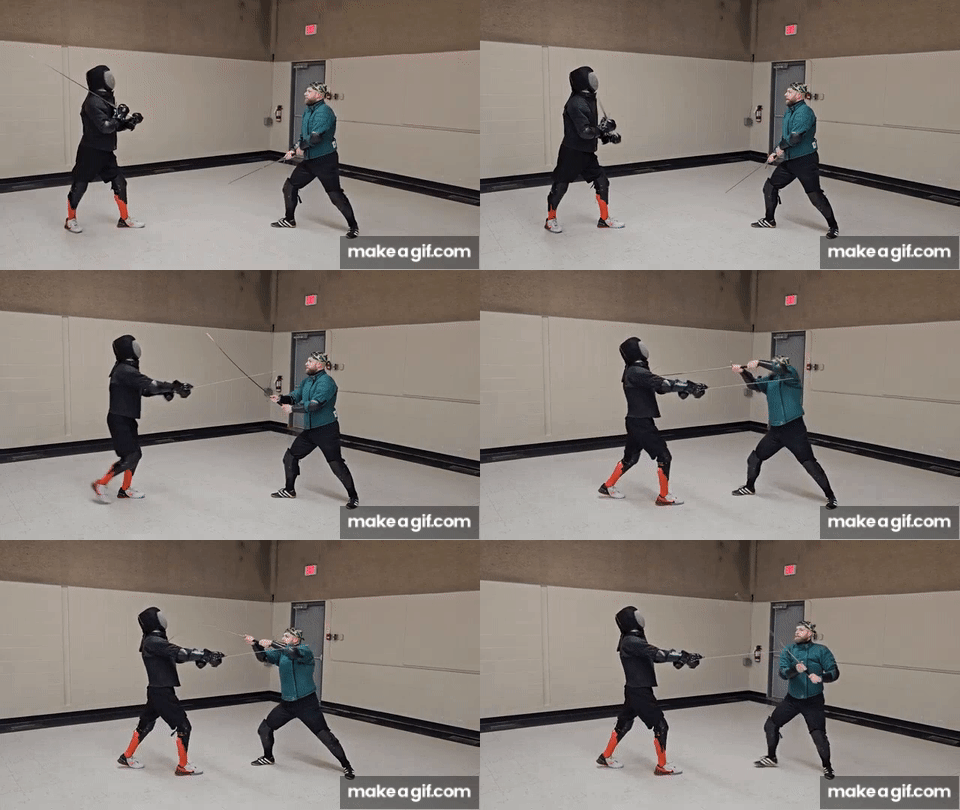
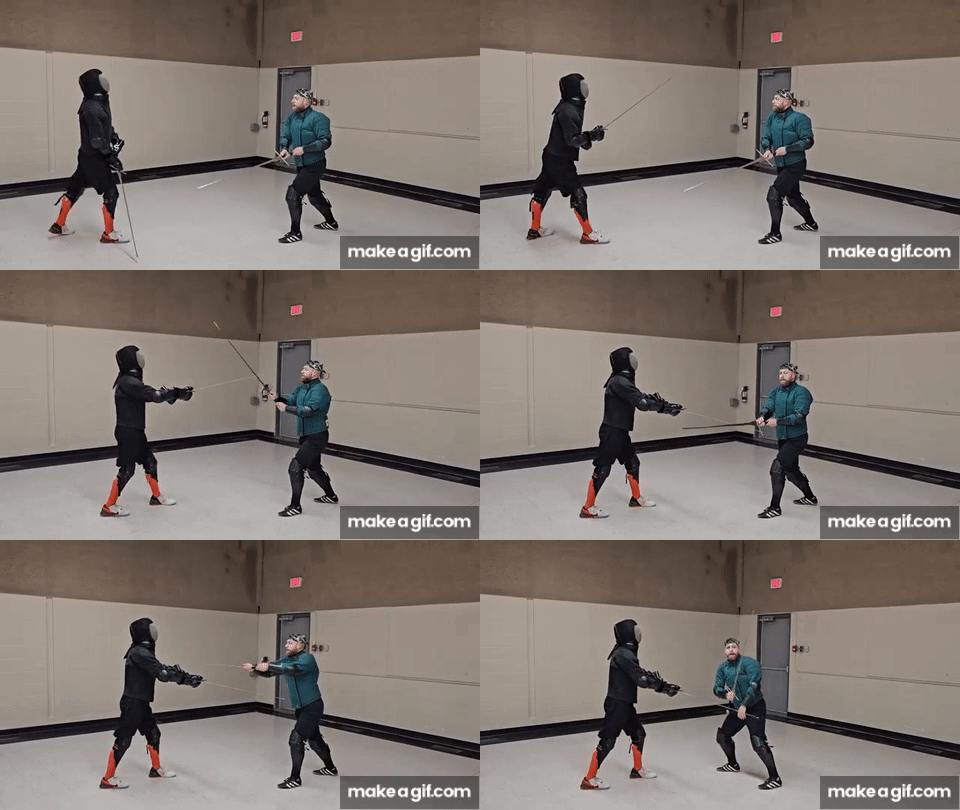
Of the three, I find the circle parry version the most interesting.
The rising parry with the back or front edges will work, but I’m not sure they match the text entirely. For one, while they may begin from Pforte they do not end in that position. The back edge rising sweep is also a bit textually doubtful in terms of its place within Liechtenauer fencing12.
The circling parry both begins from Pforte and ends there. As I discussed in the video, “pinning” the opponent’s sword down with this position, when done at the right angle, makes it difficult for them to disengage out of it. Also, as a circle parry, it sweeps a wide range of angles and makes it easier to find the opponent’s blade no matter what line they choose to attack on. It’s also the only version I can tell which would somewhat resemble Pfobenzagel.
The downside of course is that it is somewhat more complex as a movement and takes more time to execute. This may make it less reliable under pressure, but then that is why this technique is one that we “lere wol”.
You could also argue that it is difficult to reconcile the idea of a circle parry with doing the Absetzen “strongly from the ground”, whereas the more percussive beats with the front or back edge seem better fit that description.
It also should be admitted that “pinning” the opponent’s sword down with Pforte all the way to the ground may make it impossible to land the thrust or to strike the opponent’s feet, so that idea does clash with the text. The less exaggerated circle parry, ending in a position ready to strike, is more textual.
Placing Absetzen within the Tactical System
The next question is: What role does Absetzen fulfil within the defensive systems of Liechtenauer fencing?
There are many defensive tools within Liechtenauer fencing and within Ms3227a: The vorsetzcen, the hengen, abwenden, specific techniques like Czornhaw and Krumphaw, and so forth. When and why would we choose to use Absetzen specifically?
One possibility is that Absetzen is the preferred defence from the low positions. If you find yourself fencing with your point towards the ground, Absetzen may be your best defensive option. Both the rising sweeps and the circle parry proposals I outlined give you a versatile defence from a point low guard.
This of course then simply reconfigures the question. Rather than asking “Why use Absetzen?”, we instead must ask “Why fence from point low positions?”. Unfortunately, Ms3227a is not very concerned about its guards and doesn’t really tell us why we would use one over another. There is more to come about this issue of guards in a future article.
Another idea might be based on “Whoever makes a thrust at you, / Your point meets theirs and breaks on through.” That is, the Absetzen is the preferred defensive tool against an opponent attacking with thrusts, enabling us to defend and thrust effectively in return.
It does work in this application, however the text also states Absetzen can be used on cuts or thrusts, and there are other defences which are stated to have the same use: Vorsetzcen, the Unterhengen, Abwenden, etc. I suppose it is possible that Absetzen falls within the category of Vorsetzcen, although I am somewhat reluctant to take that approach because it starts making Vorsetzcen as a category so broad as to be basically useless. I also don’t think Absetzen matches well to that category.
In conversations on this matter, Jess Finley and Michael Chidester proposed to me that what makes Absetzen Absetzen is the tactic and not the mechanical action. As they see it, “Absetzen” means offering the opponent an apparent opening to attack, and then closing that opening with the Absetzen and striking them in return. Thus Absetzen is more of a tactical trap than a purely defensive tool.
This idea has much to recommend it, however it is somewhat in tension with 3227a’s overall emphasis on taking the initiative with vorschlag.
Another intriguing idea I am playing with along these lines is using Absetzen as a defensive trap mid-engagement. I have had some good success with engaging my opponent with attacks, and getting them into an exchange of blows and parries. If one or two nachschlage have gone without a strike being landed, I back off and lower my blade to offer an opening, and then ‘Absetz’ when the opponent attacks instinctively for the apparent opportunity at hand.
This is all getting pretty outside the text though. This is one area where I very much regret the gaps within Ms3227a. I very much would have liked to read what our friend the Author thought about this technique.
The most textually based possibility I can currently offer about the tactical role of Absetzen is defending ourselves from point low positions. If we end up with the point low, however that happens, and the opponent attacks us, then Absetzen gives us a tool for retaking the initiative with an efficient parry-riposte.
Conclusions
To return to my earlier question about RDL’s Absetzen vs 3227a’s Absetzen: It does seem that 3227a’s Absetzen is a different kind of action than what the RDL texts describe.
There are some distinct similarities: Both techniques seem to involve the opponent attacking an offered opening, and using the opponent’s attack as an opportunity to set up a strike of your own with a parry-riposte.
The RDL Absetzen however seems to work via winding from the point forward Pflug, whereas 3227a Absetzen I think is an upward striking or circling parry from the point down positions.
I did find it very intriguing that 3227a has an absetzen variant that is launched from the lower hengen, which seem to be its equivalent to what RDL calls Pflug. If we accept that 3227a pre-dates RDL (which is plausible, even probable, although not certain), then perhaps that suggests a degree of evolution: Absetzen from the lower hengen began as a variant on the point low Absetzen, and then later evolved to become the preferred version for whatever reason.
But such musings are just speculation.
My next steps are to train this technique further and try to identify why one would use Absetzen specifically, and hopefully better identity how it is distinguished from Vorsetzcen and other elements of 3227a’s defensive system.
I hope this analysis has been interesting and enlightening to you, and has given you new avenues to explore as well! Happy fencing!
Liechtenauer’s Sweeping Parries
Ibid.
Specifically, this line In aller lere / deyn ort keyn eyns gesichte kere are given in the armoured fencing on foot section of the Liechtenauer Zettel in other texts. 3227a uniquely re-purposes or re-contextualizes them into the unarmoured fencing.
“Pforte”, the Gate, is also mentioned in that passage.
In practice, I would aim this technique at the shin guard of the training partner, for the sake of safety. Striking the feet is likely to injure someone wearing only thin fencing shoes.
See my previous article “Liechtenauer’s Sweeping Parries” for more details.
Looking good, Eric! I am glad to see you are doing well!