
Umbe Schreiten
Offensive Footwork in Ms3227a

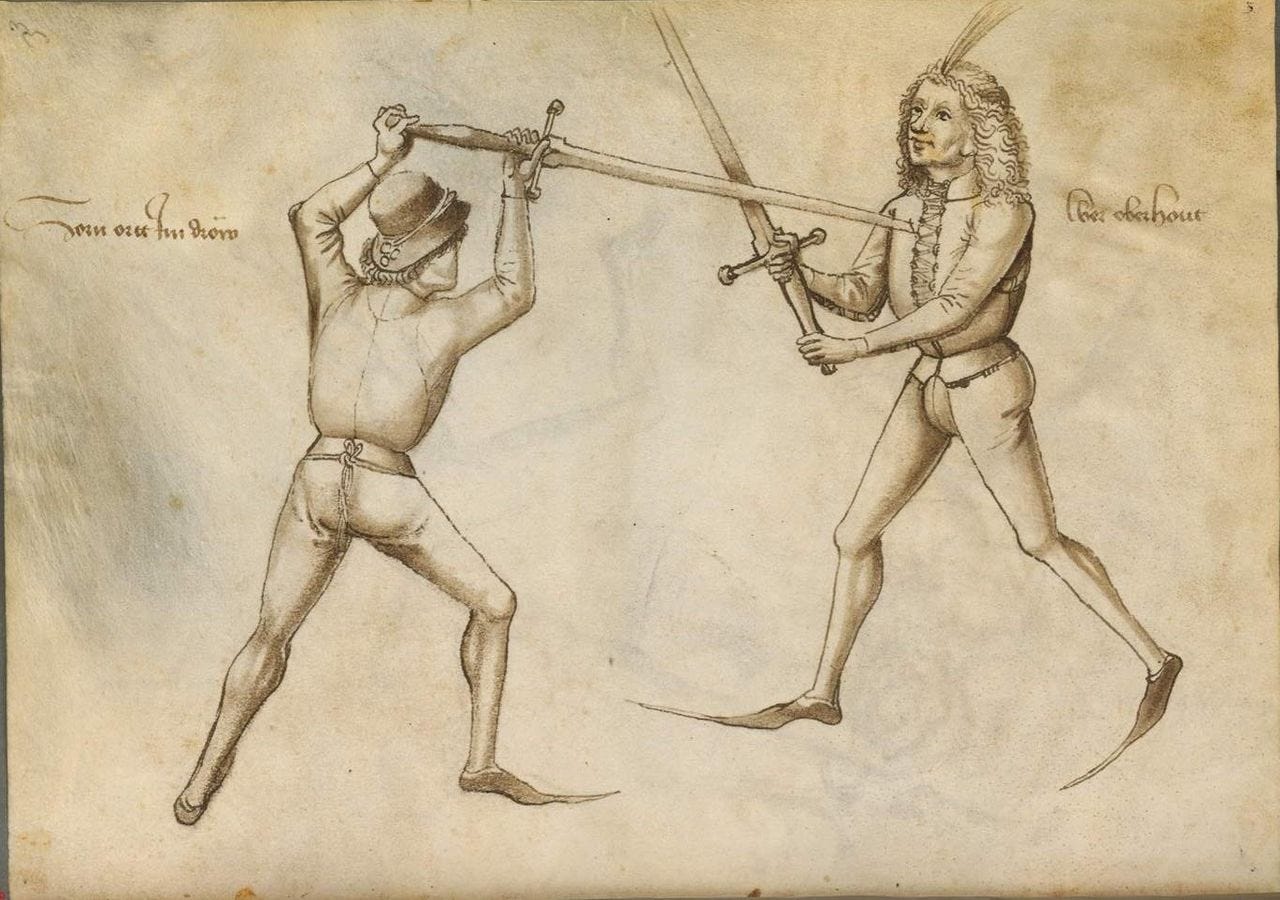
Fencing is an exercise of the entire body. A technique with the sword will often utilize every part of the fencer. Even small movements like the squeeze of the fingers or the turning of the hand can be crucial.
The foundation of all techniques always comes back to footwork. Footwork is how the fencer manages their distance, and therefore manages the essential factors of time and timing. Footwork also generates power, manipulates angles, and enables certain movements while precluding others. The best fencers in HEMA always display confident and capable footwork.
One of the more useful things which the Nuremberg Codex offers the HEMA practitioner is more advice and guidance on footwork than other Liechtenauer sources.
Furthermore, when you fence with someone, take full heed of your steps and be certain in them, just as if you were standing on a set of scales, moving backward or forward as necessary, firmly and skillfully, swiftly and readily.
[…]
You should also have moderation in your plays and not step too far, so that you can better recover from one step to the next (backward or forward, however they go). Also, two short steps are often faster than one long one, so you will need to do a little run with short steps as often as you will a big step or a leap.
This isn’t a whole lot of footwork advice in comparison to say a modern text on fencing, but what is here is generally good and practical advice.
To understand the fencing style and tactical approach of the Codex, we need a firm understanding of its footwork. A lot of work has already been done on 3227a’s footwork, in particular Maciej Talaga’s excellent video on the subject1. Today, I want to address one particular piece of footwork: The umbe schreiten, or “stepping around”.
This is an important puzzle piece of the Codex. The text seems to advise using this footwork offensively, when launching attacks on the opponent. As the Codex generally prefers to seize and keep the initiative via offence, understanding its offensive footwork is critical to fencing in this style. However, umbe schreiten presents certain challenges to reconstruction and application in practical fencing today. We will discuss those, and I will present my own proposal on how to reconstruct this action, as well as make some experiential remarks on its tactical effects and training suggestions.
Textual Analysis
The key umbe schreiten verse is on Fol 19v of Ms3227a.
German: Auch meynt her das / eyner den hewen nicht gleich sal noch gehen vnd treten · zonder etwas beseites / vnd krumbes vmbe / das her ieme an dy seite kome / do her in bas / mit allerleye gehaben mag / denne vorne czu / was ′her ′denne[78] nür of ienen hewt ader sticht das mag im iener mit keynerleye durchwechsel ader andern gefechten / gel / wol weren ader abeleiten / nür das dy hewe ader stiche gleich czum manne czu gehen keyn den blößen / czu koppe ader czu leibe / mit vmbeschriten / vnd treten
Chidester translation:
He further means to not directly track and follow your cut with your feet, but rather move aside a little and curve around so that you come to your opponent’s flank, since you can reach them more easily from there than from the front. When your cutting and thrusting goes directly toward their exposures (toward their head or body) while stepping or treading around them, then those strikes cannot be defended or diverted by changing through or other such plays
Trosclair translation:
He also means that you shall neither move nor step directly behind your attacks, rather, do it somewhat sideways and curved around so that you come to the side of the opponent, where you can get at them better with everything than by frontally on.
Whatever you subsequently cut or thrust at the opponent at that moment, cannot be defended nor lead off well by them by disengaging in any way nor by any other techniques, provided that the cuts and thrusts go in directly to the openings, be it to the head or to the body, with lateral movement and stepping.
I have provided both the Chidester and Trosclair translations here. However, I don’t think any major differences emerge between these two versions. This passage follows a description of your starting stance and how to strike at the opponent:
Also notice and remember that when he says, “If you would bring the art to light”, etc., he means to advance your left foot, and with that, cut straight toward your opponent with threatening strikes from your right side, just as soon as you see where you can take them and would certainly reach them by stepping.
He also means that when you want to fence strongly, fence with your left side leading, and with your entire body and strength, toward their head and body (whatever you can get) rather than toward their sword. In fact, you should strike as though they had no sword, or as though you couldn’t see it, and you shouldn’t disdain the skirmish or harrying, but be always working and in motion so that they cannot come to blows.
Chidester version here again.
So from these quotes, we can start seeing an outline of umbe schreiten: Our sword is moving directly towards the opponent’s openings, but our footwork is taking us laterally towards the opponent’s flanks rather than directly at them.
Which attacks are we using with this footwork? The text is pretty vague, which implies to me a full range of attacks. It talks about “hewe ader stiche”, both cuts and thrusts. As I interpret this, this would mean umbe schreiten should be useful for most attacks described in 3227a. As I have argued before, it is my view that these attacks aim to connect with the point of the sword, for maximum reach.
An earlier passage on Fol 16r gives us an important piece of information about which direction we are to seek the opponent’s flank:
Always go to their right side with your plays, because in all matters of fencing and wrestling, you can better take your opponent in this way than directly from the front. Whoever knows this piece and brings it well is not a bad fencer.
Here our first quandary emerges: When the text says to go towards the right side, are we going to the right from our point of view, or are we going to the opponent’s right side? If we’re going to the opponent’s right side, that would be our left. This passage says “their right side”3, which could mean the opponent’s right or could mean the opponent’s right from the fencer’s point of view. It’s unfortunately not particularly clear.
For what it’s worth, Maciej Talaga has told me in personal conversations on this matter that he prefers seeing it as moving towards the fencer’s right. Michael Chidester and Christian Trosclair’s translations seem to favour the opponent’s right/the fencer’s left.
I do not have the expertise to judge who is more correct here. However, the earlier passage does state to strike from our right side when we see that we can reach the opponent certainly with stepping. It is possible to strike from our right to the opponent’s right, e.g. with Krumphaw, but techniques like the Twerhaw are not described in that way. Stepping with our right foot towards the opponent’s right side is also possible, but in this text these are referred to in the messer section as schilt trete (“Shield step” or perhaps “squint step” a la the Schilhaw), and not umbe schreiten. Additionally, non-3227a Liechtenauer texts such as the Ringeck gloss call for the fencer to use a right foot step when they cut from their right side. All told, I feel moving towards the right is more probable but I’m not highly confident about this.
The 19v text is also good enough to tell us why it wants us to step in this way. It claims we will reach them “better” or “more easily” by attacking upon a flank rather than stepping directly behind the cut. Additionally, attacking directly while stepping around will make it more difficult for the opponent to defend themselves with Durchwechsel (disengaging)4
We also should note that this movement is umbe schreiten. If Talaga is correct in his analysis of 3227a’s footwork terminology5, the term schreiten implies a passing step, bringing the rear foot to the front.
Talaga:
Notably, schreiten is presented as synonymical to both springen („leaping, jumping”) and lawfen („running”, lewftche mus tue~ / mit korcze~ schrete~, fol. 15v) and lacks the extending/shortening function characteristic of treten (vorlengen/körczen, fol. 19r; see below for more). This suggests that schreiten is a movement that, at least in some situations, can show considerable dynamics and moves both feet in a similar way, without extending the body – the text states explicitly that it is possible to „spring into the scales” (sprink yn den wogen, fol. 27r), i.e. a balanced position, neither extended nor shortened. That this may be a far-reaching and dynamic movement seems corroborated by its apparent connection with flexibility/agility (gelenkheit, fol. 17r). Hence, especially given its connection to running (lawfen), the term schreiten seems to gravitate towards passing steps, running attacks, or even modern Olympic fencing fleche.
However we reconstruct umbe schreiten, I believe it also has to be consistent with the other principles of footwork and fencing presented in this text. That means that short steps are often preferable to long ones. We want to be balanced and measured and not overcommit in our movements, so that a forward step can be followed easily by a rearward step if necessary.
At the same time, this text wants us to take the initiative with vorschlag, and preferably with direct actions on the shortest paths towards the closest targets. This footwork must support us in taking an effective, well-controlled, and well-conducted offensive on our opponent.
The Tactical Challenge
The umbe schreiten has two described tactical effects in the above passages.
Support cuts or thrusts aimed at the opponent’s body, not at their sword. It is claimed we can reach more easily this way.
Hinder the effectiveness of an opponent using durchwechsel.
To illustrate why these two effects may be useful, let’s consider what would occur if we don’t follow this advice. Let’s assume we are an anti-Codex fencer, and so we will attack by striking at the opponent’s sword and stepping directly towards the opponent after our cut as we do.
Helpfully, this clip from Akademia Szermierzy’s “Understanding fencing actions”6 illustrates precisely what 3227a does not want us to do.
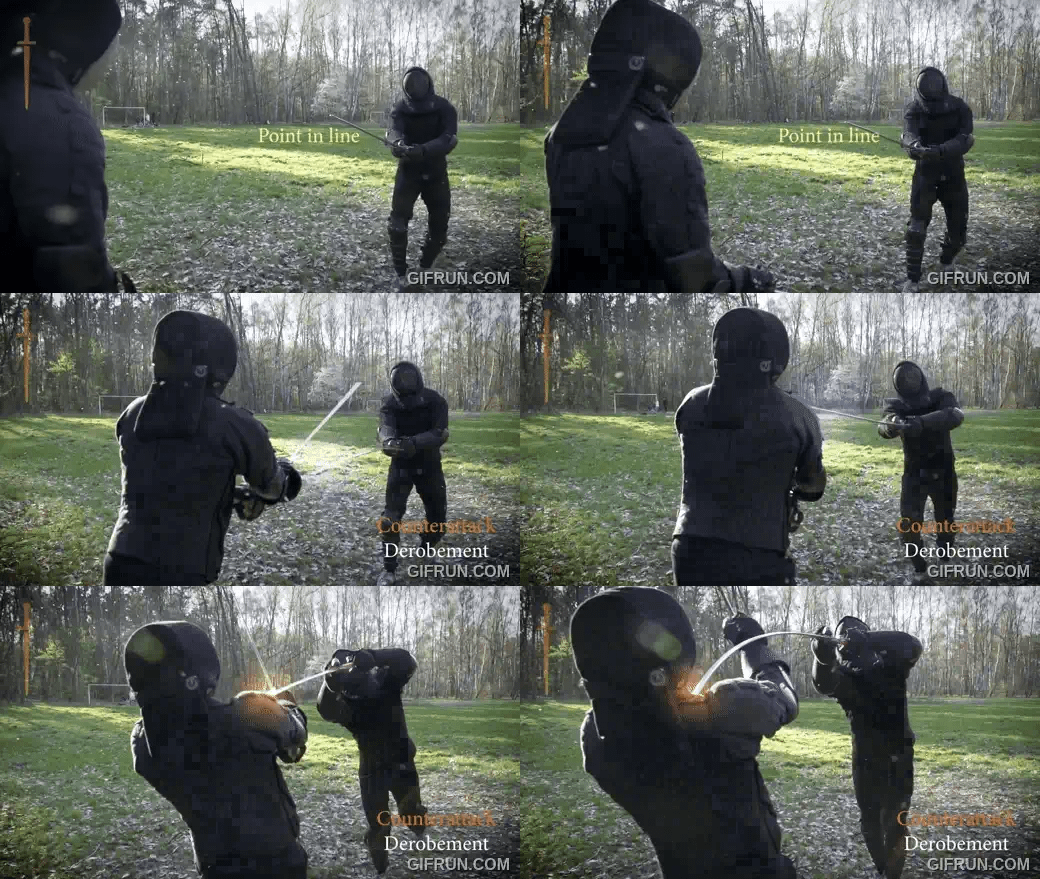
A forceful strike aimed at displacing an opponent’s blade is an ideal affordance for using a disengaging attack such as this derobement. By voiding the blade out of the way of the strike when the attacker’s force and momentum has been committed laterally, the defending fencer can create a window of opportunity to launch a decisive thrust before the attacker can recover.
This is also true even if the defender’s blade isn’t on line. If the defender’s point is up in a Vom Tag or down in an Alber and the attacker attacks towards the sword, it is quite easy to avoid binding and strike whatever is most available.
Secondly, by advancing directly towards the opponent we are bringing our body closer into the opponent’s reach. At the same time, by striking at the sword we’re not threatening the opponent while we bring our targets closer. A non-threatening movement combined with an advance is, classically, considered ideal for counterattack or stop-thrust.
So the Codex’s advice here is quite sound, overall. We don’t want to give the opponent such an easy chance to strike us while we’re taking the initiative. Striking directly at the opponent is indeed a good way to prevent them from using disengaging tactics on us. Why step laterally while doing so?
The Geometry Problem
This brings me to the issue of geometry. This matter is a little hard to describe clearly in words, so I have built you an extremely professional diagram to illustrate this problem.
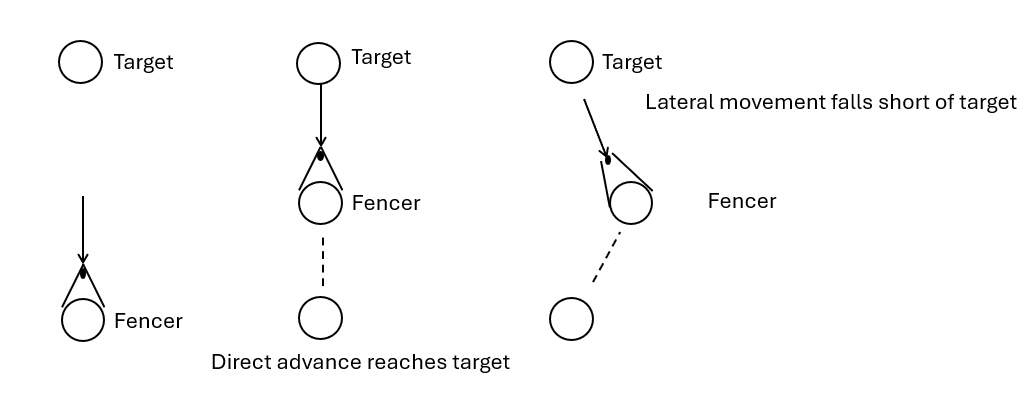
It has often been argued by HEMAists, erroneously, that any number of tactical problems can be solved by “stepping offline”. In many cases, this causes further issues. In particular, offline movement runs into fundamental problems about geometry.
In brief: The shortest distance between point A and point B is, always, a straight line. In the case of a human fencer, we have our greatest forward reach with our arms fully extended and roughly level with our shoulders or chest. To strike our opponent with our sword, we have to get our shoulders close enough to bring the target within the arc of our strike. If we are out of range of our target, and we begin to strike, a step directly forward at the opponent will be the shortest way to reach them.
The more you angle that step laterally, the further away from the target you take your shoulders and therefore the harder it is to reach the target. At a certain degree of angle, you will no longer reach with a step.
This is fairly intuitive to understand in live fencing. When you’re trying to reach the opponent with an attack, you will almost invariably, instinctively, step directly at them. A step straight to the side obviously does nothing to help you reach. Yet how often do HEMAists say “Simply step offline” when we’re discussing tactical quandaries? In my view, all too often and all too reductively.
In umbe schreiten, the text tells us both to move to the side, and to strike directly towards the opponent’s openings. How to reconcile this contradiction? To me, this implies that we should find the right point of balance between direct and lateral movement.
Move like a Knight
With our umbe schreiten, the movement should mainly be direct and linear. However laterally we go, we still have to cross the gap between us and our opponent such that we can threaten their body with our strikes. Hence, the step should be mostly forward towards our target. The umbe schreiten shouldn’t be a circling movement.
Next, even though we’re mostly going forward, umbe schreiten still has a lateral component. The text tells us that this step takes us towards our opponent’s flanks and doesn’t follow directly after our cuts, even though our cuts are directed straight at the openings. Therefore, as I interpret it, umbe schreiten should be mostly forward and a little to the side. We can draw a metaphor with the knight of chess, who moves two squares linearly and one square laterally in all his movements.
How far to the side? Here I agree with Talaga on this point: The critical criteria is defending us from the opponent’s durchwechsel. In short, we need to go forward far enough that we will threaten the opponent with strikes, but also go to the side enough that the opponent won’t have an easy time hitting us by disengage. If the opponent tries a disengage anyways, the umbe schreiten should support a direct hit in the timing window of their disengage.
Why is this lateral movement a defence against the durchwechsel? The text doesn’t elaborate, but I think some insights from experience helps me understand this.
3227a repeatedly tells us not to over-commit to movements or attack too impetuously or too forcefully. When I over-commit in my attacks, I often am left unbalanced and forced to make recovery steps forward (e.g. After a fleche). If my initial attack has failed or been parried, or disengaged, recovering forward can be disastrous. You may be severely exposed to the riposte, you may run into your opponent, or you may end up corps-à-corps with the opponent in a close range brawl. This often results in either grappling or a quick-draw Twerhaw fight. Either can get very messy very quickly, which is at worst annoying in sparring or competition but could be very dangerous if you’re “fighting for your neck” and risking injury.
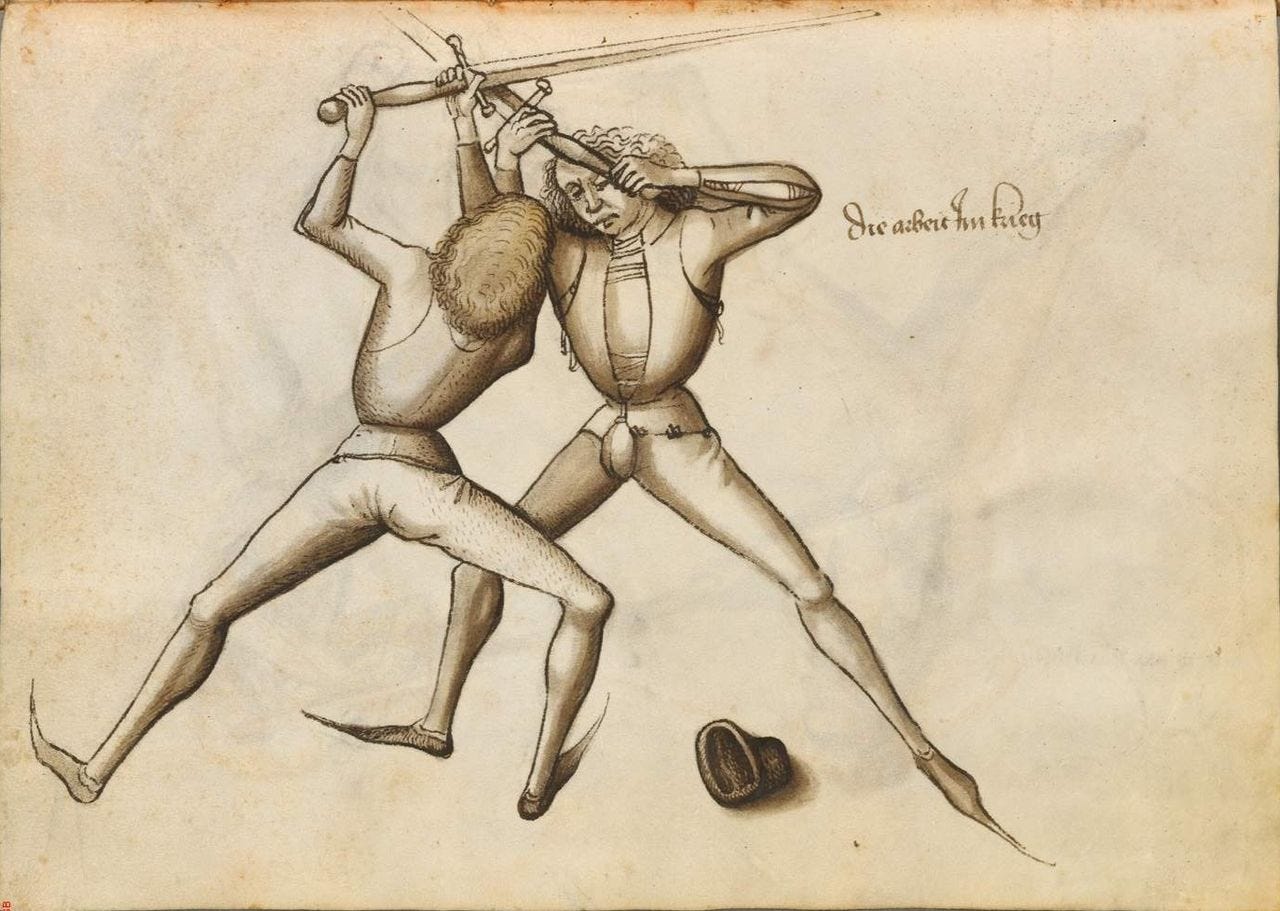
Similarly, if you’re recovering forwards into the opponent, you are also quite vulnerable to a disengage. You’re bringing your body closer into the opponent’s range, meaning they can disengage with their point low into your low lines (i.e: Stomach, hips, groin, legs) and still reach you even if your sword is covering your upper openings. They have a wide range of potential targets they can reach, and you’re advancing into their point which helps them do so.
If your step has a lateral component, you are necessarily not advancing forward so much. This will mean if an opponent tries to disengage into a low line, they will not be able to easily reach those targets. If your blade is covering your upper lines (e.g: With Twerhaw), you should in theory be relatively safe.
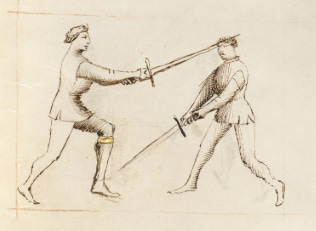
In my experience, the lateral component of umbe schreiten forces me to be measured and controlled with my attacking footwork. By balancing between moving forward and moving sideways, I avoid endangering myself through overcommitting forwards. This leaves me with more space and time for fuhlen, using the hengen and winden, and other such things. At the same time, the necessity of reaching the opponent and forcing a parry requires that I move forward enough to genuinely threaten.
Proposed Physical Interpretation: The Floating Foot (plus some tactical discussion)
Now that we have defined what we are trying to achieve with umbe schreiten, and why it must combine both forward and lateral movement, let us discuss a specific reconstruction. Please note that I am not claiming this is the definitive or absolutely correct umbe schreiten at this time. This is just a proposal.
One of the more influential footwork patterns in HEMA today is the “ballistic passing step”. The previously linked video from Anton Kohutovic demonstrates this. The essence of the “BPS” is striking with a cut or thrust by full extension of the arms and a forward lean of the body, unbalancing yourself forward (the “ballistic” element of the step) and then recovering balance by catching yourself with the passing step. This results in an explosive attack which should hit its target while the stepping foot is still in the air. In theory, this also results in an explosive attack which can hit faster than the opponent can make their parry.
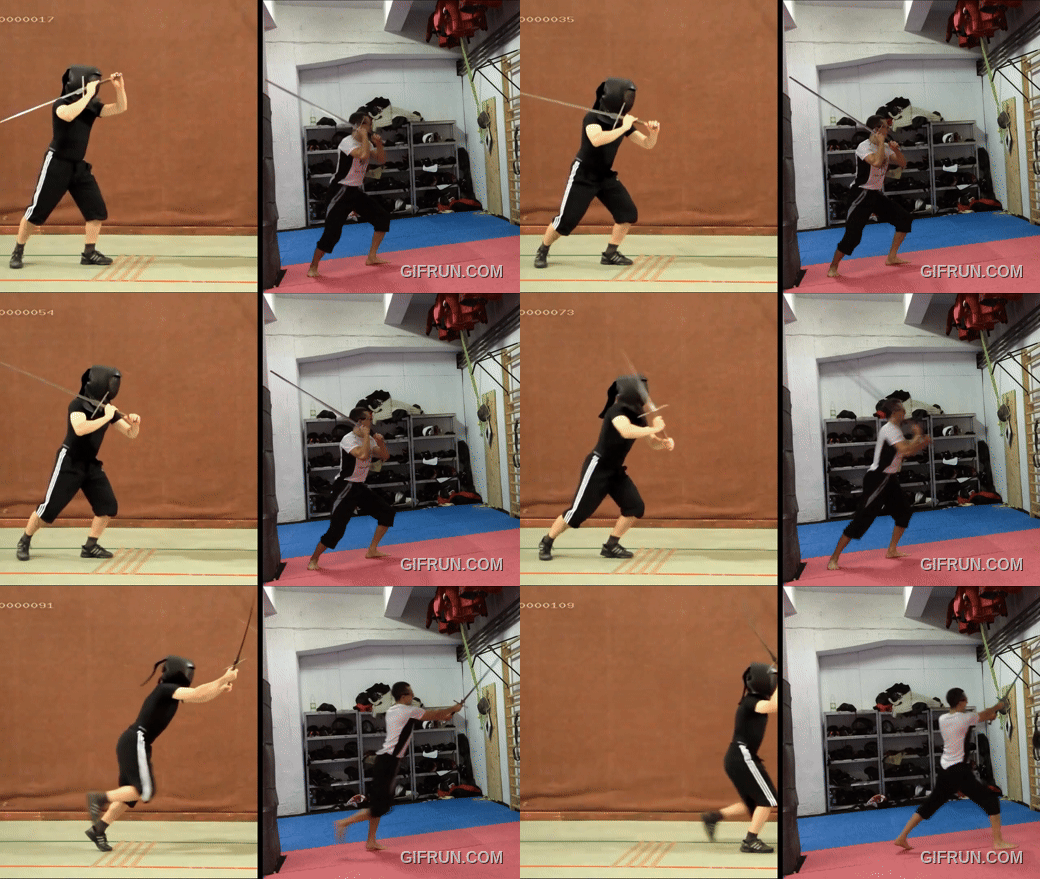
Some time ago I was discussing the issue of umbe schreiten on one of the HEMA Discord servers I frequent. Tea Kew suggested to me that I could do this footwork with a BPS using a “floating foot”. The idea here is to still extend forward explosively with the step, but let the rear foot ‘float’ a bit during the step, so that we can re-direct our recovery laterally. In theory, this should look a bit like this:
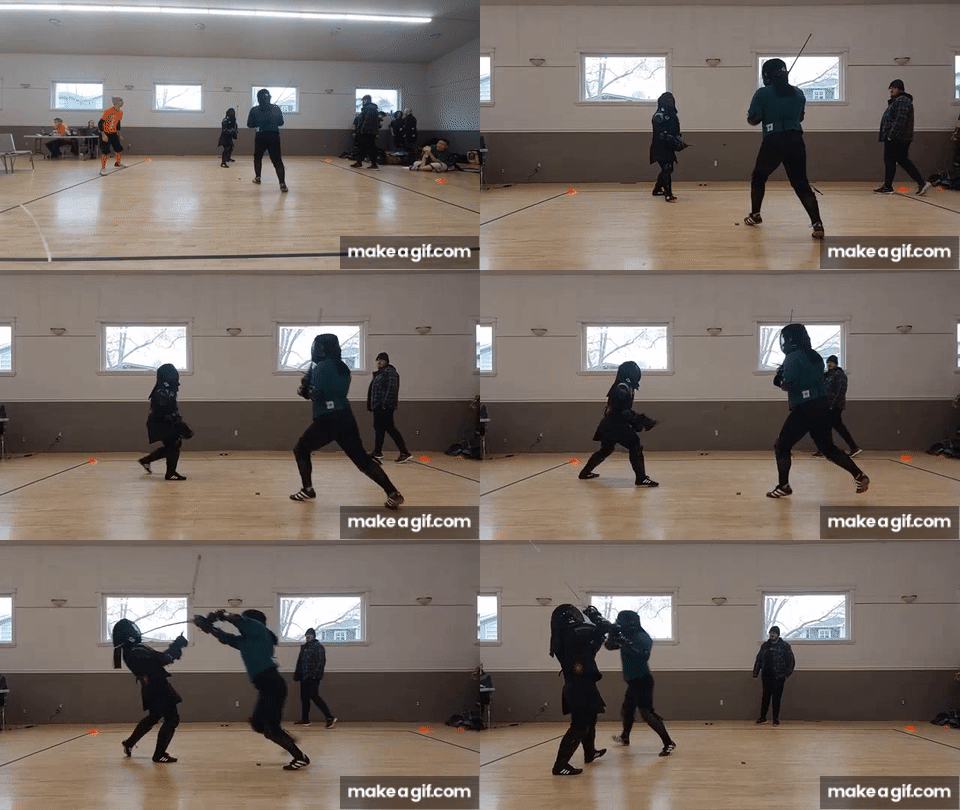
This isn’t strictly a vorschlag, but I think it demonstrates the idea: I strike directly, and recover off-line laterally.
The key advantage of this interpretation is how it resolves the geometry problem of lateral movement. As a ‘ballistic’ movement, it aims to land the strike on the forward extension of the arm and body rather than with the completion of the step. Therefore, the strike can still be made straight and direct to the closest available opening, as if a string is pulling my point to the opponent’s target. This helps ensure that the vorschlag is a genuine, legitimate threat to the opponent.
The lateral component of the movement is then relegated to the recovery phase of the footwork, bringing me back into balance after forward extension momentarily unbalances me. Recovering laterally to the right has some advantages.
First of all, I don’t inadvertently run forward into my opponent. By not recovering directly forward, I avoid ending up in a corps-à-corps brawl. If you want to maintain space, measure, and control in your fencing, this is important. When the distance completely collapses into corps-à-corps, you often end up in a messy and dangerous situation. Lateral recovery helps mitigate that risk.
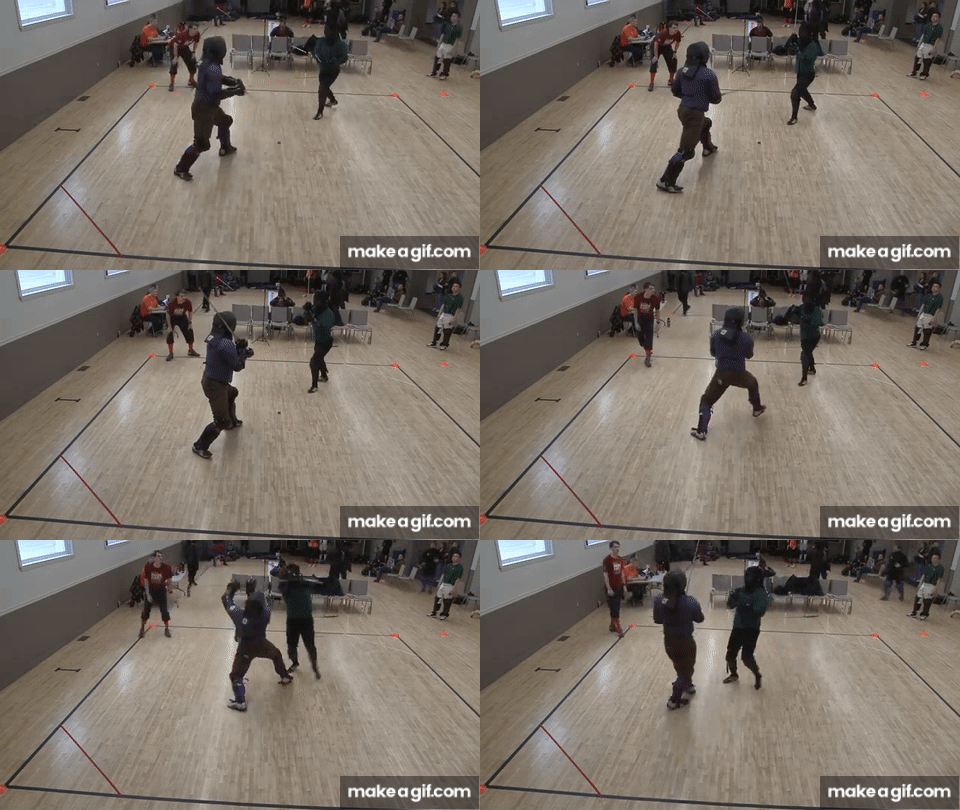
If my opponent has parried the vorschlag and we are in the bind, then recovering laterally to the right and bringing my blade into a hengen helps position me for continuing the fight. In practical experience, I have found if the opponent remains extended then from this position I can take a strong bind and drive in a thrust. If the opponent leaves the bind with a wide action I can interrupt them with an attack to their closest target, usually an arm.
If the opponent withdraws as my vorschlag is launched, as often happens, then the lateral recovery helps ensure I don’t “chase” them. This does at times surrender offensive opportunities. However, when I deal with an opponent who relies on backpedaling parry-riposte tactics avoiding the chase is important to maintaining safety.
Of course, the space-maintaining aspect of the lateral recovery also keeps the distance wide enough that my opponent can’t easily disengage and strike my low lines. When properly executed7, the opponent finds my low targets too far away for a low disengage. At the same time, the direct threat of the vorschlag means that trying to disengage risks taking a direct hit before anything can be done.
A potential problem with umbe schreiten is that the opponent may perceive that you continually step towards the side, and then may set up a counterattack to that side that you step yourself into. I myself have found in fencing that I walked my right flank into an opponent’s cuts many times while learning this footwork. However, the error I was making here was launching vorschlag from too far out of range. As a result, they could discount the non-existent threat and hit me at their leisure. If you cannot threaten them on the direct line with the vorschlag, then you become easy to exploit. Successful umbe schreiten relies on a genuine threatening vorschlag to the opponent.
I have also experimented with variations on the umbe schreiten which depend on making multiple short steps. An example might be an attacking step directly forward and then pivoting out to the right with the back leg
However, after some experimentation and thought I realized that, when successful, these were really just the same idea as the ‘floating foot’ concept. If you are throwing your strike directly at the opponent’s body, as if a string was drawing your point to the opening, then you will tend to optimize towards hitting on the forward extension of the sword, arm, and body. After that, you can do any number of things with your feet to regain balance: A big step, a short step, multiple steps, or what have you.
This is I think a benefit of the flexibility of the ‘floating foot’ approach: You can vary how you step around depending on the situation and context.
There may be other possibilities for umbe schreiten. But so far, this has been the interpretation I have found the most success with.
“Jousting” Footwork
The critical weakness of lateral movement in longsword fencing is generally shortened range. The lateral aspect of the movement must shorten your reach, by simple dint of the geometries involved. The more laterally we move, the more we lose reach.
If the opponent steps backwards directly while we are advancing in a lateral fashion, they will typically escape our reach. Backpedalling tactics like this, particularly with the parry-riposte or counterattack, is not something the Liechtenauer sources seems to address. For myself personally, it’s often a weakness. When I chase a backpedaller, with some skill they can pick me apart.
Is there an answer? So far as I have been able to tell, the best answer lies in getting the opponent to advance into our vorschlag.
Several years ago now, Jens Kleinau published his own interpretation of Vorschlag and Nachschlag that mentioned these ideas of hurten and rauschen8. It may be worth quoting some of this here:
The small paragraph itself is about distance and timing in a situation in which the opponent is approaching. The author recommends that if the opponent gets near and may think of himself that next he will be in the distance to attack the fencer, the fencer should not hesitate but step in and strike to an opening at the opponent. Here we meet the term “hurten” which created some trouble in translation. The word “hurten” stems from the tournament, it’s the expression for stepping in and doing a thrust or cut (“hurten unde stôʒen, Albr. 9,35; hurten und slahen, Bit. 9134.”; Lexer dictionary). The word “hurry” has something to do with this term in the original meaning, but the today meaning is not the same. In the term of fighting and jousting it is doing the step into hitting measure before the opponent does it. The modern perception created a race for being the fastest, but this is not intended here. It is a tactical advice of keeping the control of the distance and not letting the opponent control time and distance. Thus the author does not care if the strike done hereby hits or not (“her treffe ader vele”). As long as the strike creates a safety distance and therefore let the fencer still be in control of the distance, the deed is done and the “Vorschlag” (whatever it is) can be won.
[…]
Two of the terms often misinterpreted are “hurten und rauschen”. Hurten was explained above and rauschen is also part of the tournament language and means charging. So “hurten and rauschen” means nothing else than step and attack with the flavour of a knight in a tournament.
Kleinau argues that these terms are derived from the language of the joust. Now, what happens in a joust?
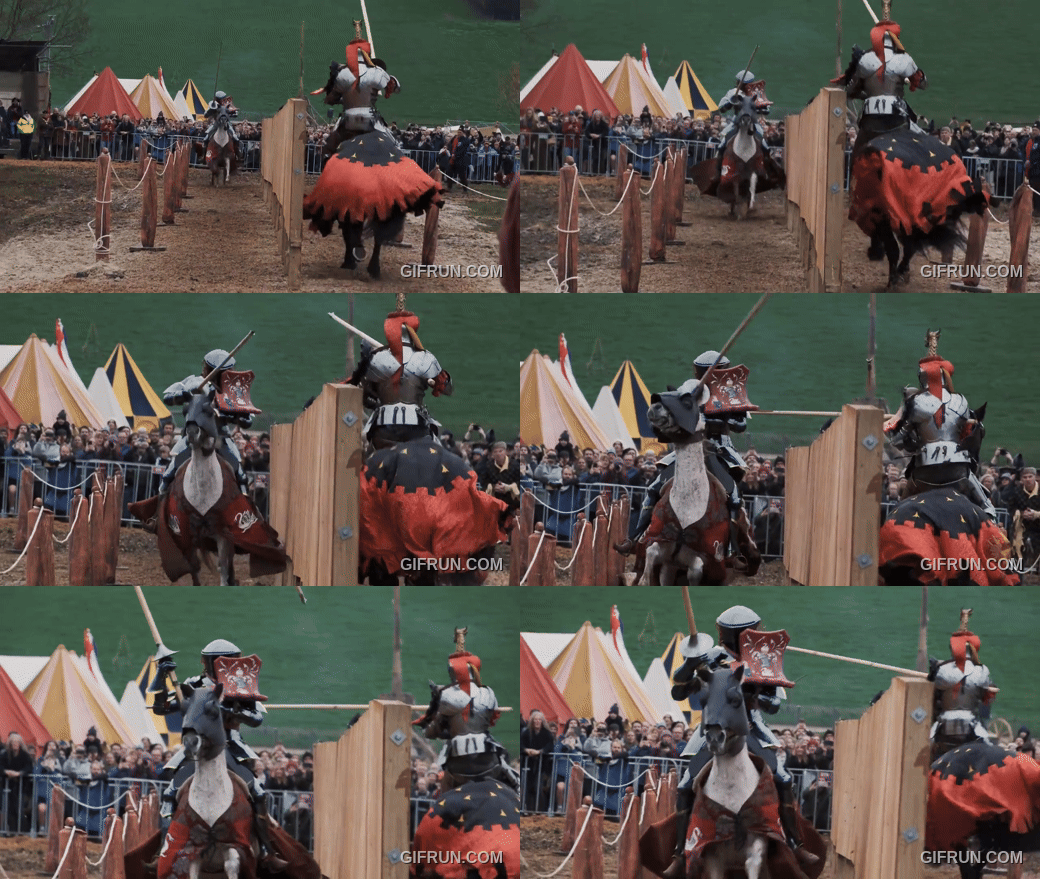
The two knights charge together. There is a mutual collapse of distance between them.
I believe that a lot of Liechtenauer techniques and principles implicitly assume that the opponent is advancing on us when we perform Liechtenauer’s fencing art. At least, the techniques seem to work best when the opponent advances.
If you can get the opponent to advance, then the opponent’s own closing of the distance can make up for any shortcoming in your reach.
Additionally, the lateral movement is more important as well when both the fencer and the opponent are advancing. As noted before, if both parties advance directly into each other with strikes we run a greater risk of a bodily collision or coming inadvertently into a corps-à-corps close range brawl. Lateral movement helps us maintain our space and distance in this situation.
It is admittedly not so easy to get the opponent to advance, particularly if they are skilful and cautious. There is a whole art in itself to inducing the opponent to misjudge their distance, misplace their feet, come too close without meaning to or to commit to an attack at too long a distance. Still, situations where I have been able to get my opponent advancing and catch them during preparation with a well-executed vorschlag are often when I have been most successful with Liechtenauer tactics.
Ms3227a states that when you deliver the vorschlag correctly, then the opponent must parry or be hit:
This is why Liechtenauer says, "I say to you honestly, no one covers themselves without danger. If you have understood this, they cannot come to blows." By this, they mean that no one can protect themselves from you without fear or injury, if you act according to the lesson written earlier: if you take and win the Leading Strike, then they must either continually defend themselves or let themselves be struck.
(Chidester translation)
What this also implies is that if you attempt the vorschlag, and the opponent doesn’t parry and isn’t immediately hit, then you have failed to execute the vorschlag correctly. So, for instance, against an opponent who is swiftly retreating and who can remain out of your reach, attempting the vorschlag in that situation will not succeed.
On the other hand, if you catch your opponent during their forward movement in a committed advance, then it will be hard for them to remain out of reach of the vorschlag. They must, as the text says, either defend or let themselves be hit. A rapid and well-executed attack during the opponent’s forward advance also leaves them with little time or space for attempting any kind of complicated counterattack or voiding action, which also increases the odds that you get a predictable parry rather than a risky counterattack. You can also further improve your margin of safety by using opposition in your attack to control the opponent’s direct lines of counterattack, a la Twerhaw.
For all these reasons, I increasingly think the ideal application of vorschlag and umbe schreiten is in a situation of both fencers mutually advancing into the engagement. The question then is how to create that situation.
Training and Practical Fencing Considerations
Now that we have covered a physical interpretation of the umbe schreiten, and discussed some of its tactical elements, what remains is training and actual fencing.
As usual, I will keep my remarks here brief. Practice is better than artfulness, after all, and the best thing for you to do, dear reader, is to go out and try this stuff yourself. I will however make some suggestions for exercises you can try and directions you can explore in your training.
For myself, I found it important in my training to hone my instinctive judgment for the exact angle of lateral movement I could step to while still reaching my target on a linear and direct path. There is a degree of laterality that will make your strike fall short, and another degree where you can reach. I used training with my pell at home to develop this sense on a stationary target.
What I did was started with my blade in contact with the pell, then withdrew to a Vom Tag on my shoulder with a pass backwards. I practiced several times making a direct cut or thrust from Vom Tag with a direct step towards the target, and then started varying the angle of the step laterally more and more with each cut until I no longer reached the pell. When I could no longer reach due to lateral angle, I started angling back towards the pell until I could reach on my strike again. In this way, I helped develop a judgment of how far laterally I could go while still hitting my target.
This practice gave me more confidence using this lateral stepping in live fencing with my partners at my club.
In my sparring practice, I tried to focus on setting up situations to use umbe schreiten against an opponent’s advance or against an opponent committing to remaining stationary. Back and forth footwork of my own was very helpful here: A short advance of my front foot often indicates whether the opponent is primed to retreat or will commit to remaining where they are. Drawing back a little can also prompt the opponent to advance after you. If you can get the opponent to follow you in footwork in this way, you can set up umbe schreiten at your preferred timing.
One mental rule I adopted was that I would only consider my vorschlag successful if combined with umbe schreiten. That is, if I made a vorschlag and hit but stepped directly forward at or into the opponent afterwards, I still considered that an unsuccessful hit for myself.
I started by applying umbe schreiten with the simple dominant side oberhaw. As I have gained confidence in this action, I have started applying it with thrusts, Twerhaw, Schilhaw, and other types of attacks. I would recommend a similar practice for yourself.
A useful way to exercise this action may be through a variation of the direct attack game. My thinking here for a drill would be:
Fencer A must start in Vom Tag and their goal is to strike Fencer B in the upper opening with an oberhaw. They start at a specific distance from Fencer B, but can use whatever footwork they like to attack.
Fencer B can either parry the strike or counterattack on a low line. They win if they parry, they win if their disengage lands. The disengage must be made with both hands on the hilt, from a normal fencing position. They also lose if their disengage endangers themselves, i.e: If they squat down and expose the back of their head or neck in order to hit on the low line.
Every time Fencer A gets parried, they move their start line a little closer to Fencer B on the next exchange. Every time A gets hit by the disengage, they move the start line a little further away.
In theory, this game should optimize for Fencer A to strike directly at B explosively while ensuring their footwork keeps them out of range of the low disengage. However, I have not yet had the opportunity to try this exercise with my students. It may work as intended, or it may have problems I am not currently anticipating. I also think that it would be worthwhile to design a training game that uses free movement, so that the fencers can practice umbe schreiten with more realistic distance and momentum management. I still haven’t polished up my method on teaching this action. Instruction and training game design are, after all, whole arts in themselves.
Conclusions
The author of 3227a wrote of the sword that the fencer should “apply the point, both edges, the hilt and pommel, and everything which is on the sword, according to the specific role of each one in the art of fencing”.
Similarly, I would also say that the fencer must apply every part of their body in the art of fencing, from the fingers to the feet.
Footwork positions us in space and angle relative to our opponent, carries us into and out of distance, enables the generation of power, and determines time and timing in the engagement. It is essential, and therefore if we wish to understand the fencing in the Liechtenauer sources we also must understand their footwork.
3227a’s umbe schreiten is one critical piece in this puzzle, at least for the Codex’s fencing. The text calls for us to use this footwork for both cuts and thrusts, and seems to call for it in an offensive context.
My current interpretation of umbe schreiten is to strike directly at the opponent’s closest openings, aiming to land the hit on the forward extension of arm and body a la the ballistic step. The lateral component of the movement is applied in the recovery, stepping sideways to maintain space and distance after striking directly. In this way, the fencer keeps their low targets out of reach of an opponent’s durchwechsel into a low line, and they avoid collisions or unintentional collapse of distance. This also leaves more space for using tactics like the hengen and winden from the bind.
When I am successful at this, it is very hard for the opponent to avoid being hit unless they parry. The lateral movement helps control the opponent’s available targets for counterattacks, while my blade can occupy the opponent’s direct lines to my upper body. As well, positioning yourself to the side and maintaining space gives you the necessary time and distance for making actions from the bind.
But, admittedly, it is not easy and I am not a perfect fencer nor perfect in my footwork. I often mess up the umbe schreiten, or get overly eager and overly aggressive and chase the opponent. This is an action that strongly demands the measure and moderation the Codex advises us to use in fencing. It requires direct and explosive movement, correct judgment of distance and angle, and well tuned physical self-control. But, did Liechtenauer ever say his fencing would be easy? I know that I myself still have a lot of improvement to do with my umbe schreiten, particularly before I can apply it successfully in competition settings.
I hope this article has been interesting and helpful to you, and I hope to see more people advancing their own interpretations of umbe schreiten. If you think anything here is incorrect or mistaken, well I would love to discuss it further. Happy fencing!
https://wiktenauer.com/wiki/Pseudo-Hans_D%C3%B6bringer
Christian Trosclair gives it as: “the right side of the opponent”
See “The Adversary” for more about the opponent’s use of disengaging techniques.
Which the author often fails at still…